


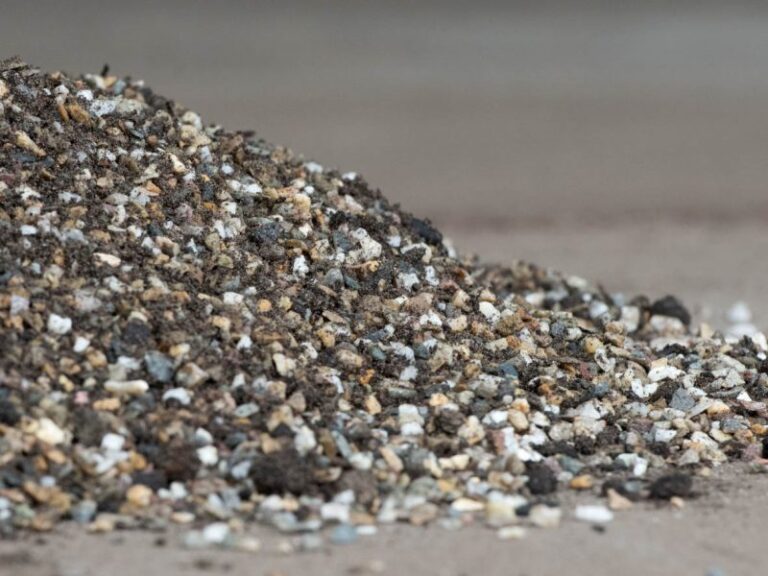
Gravel based structural soil is a medium that can be compacted according to civil engineering design and installation requirements while allowing root growth. GBSS is therefore also called a root-permeable foundation material. It is a mixture of crushed rock and soil. The base is uniformly graded gravel, the LA value of gravel, angularity and sieve size determine the strength of the GBSS. The open space between the individual uniform graded gravel can be filled with a nutrient-rich soil. (mineral and organic). The open pore volume can vary significantly from one stone type to another, depending on shape, grading, among other things. The pore volume does not indicate the bearing capacity but indicates the effectiveness for the tree. Effectiveness can vary widely by type of GBSS. The soil mix between the crushed rock should be specified on local conditions, including climate, groundwater accessibility for the trees, etc. More on the variety of GBSS in a separate article.
GBSS can be applied in two ways. Both methods have their own advantages and disadvantages.
1.) Washing in the soil between the gravel ( rocks). This is the original way of applying GBSS (known at the time as Skeleton soil ) First, uniformly graded gravel is applied in the same way as road foundation material is applied. After this, a rich soil mixture is washed in between the stones with plenty of water. Once filled, the GBSS is ready to be covered.
2.) Prefabricated mixed GBSS. This involves mixing the uniformly graded gravel ( rocks) with the appropriate amount of rich nutrient soil before processing. Optionally with additives. The prefab mix is then applied the same way road foundation material is applied. Apply per layer and compact.
Assuming both products are manufactured and applied correctly. Method 1 is preferable. However, washing in requires a lot of time on the part of the contractor, and this time is not always taken. And because checking the quality of the work afterwards is practically impossible. Therefore a prefabricated mixture is mostly preferred. It can be checked on delivery and specific variations are possible in the soil mix. In this website we only describe prefab mixtures. In the Netherlands, due to bad experiences, it is not permitted to wash in the soil.
The size of the stones, which form the supporting skeleton in the structural soil, can vary per type of structural soil.
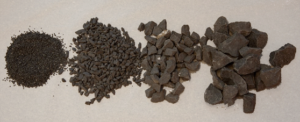
The larger the sieve size, the smaller the open pores between the stones. When compacting structural soil with a compactor, the stones are arranged in such a way that they rest on top of each other, preventing subsidence. The pores between the stones are filled with soil. The soil-filled pores provide a place for roots to grow and find oxygen, water and nutrients within the structural soil. Even though roots can take a flexible shape as they grow, e.g. roots can encapsulate the stones and grow around them. But at some point in time, the root mass/ thickness of the roots will become so large that the stones will be pushed apart, resulting in pushing up the overlying pavement.
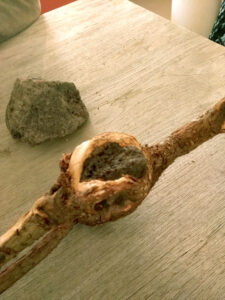
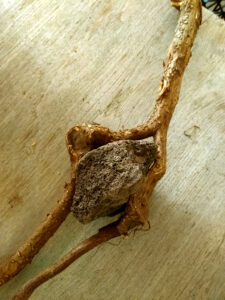
Photo taking in Groningen Netherlands
Roots found in an excavation (dd 2008) of skeleton soil based on lava 80-150mm, which was installated around 1982.
The postponement of pavement lifting above structural soil was denied for a long time. Research and observations over the years of previously constructed growing sites with structural soil show that damage to the pavement cannot be prevented and structural soil is only postponing pavement lifting. It is becoming common for manufacturers of structural soils, such as Cornell University, to make a notice “with structural soil some degree of pavement lifting cannot be completely ruled out”. Depending on the root distribution, root thickness and depth, the damage is more or less visible and/or problematic. is no longer denied, also by the Cornell University, developer of the CU-soil.