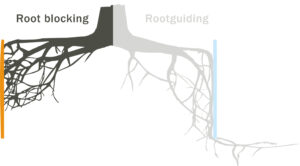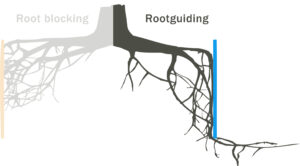

Root protection barriers are underground walls placed to block or guide tree roots (also plant roots). The main purpose is protecting trees as well structures. Structures can be underground utilities, or foundations of buildings / roads.
Visually, it is very clear. A smooth surface on both sides or a surface with horizontal and vertical ribs.
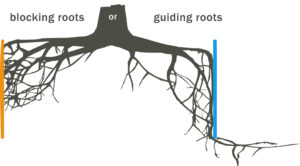
Both barrier types are made to ensure that roots cannot grow to through the barrier. Note: We are talking about tree roots here, for bamboos and similar rhizome forming plants, different guidelines apply. Not because of their roots but because of their rhizomes. Tree roots are limited in their power to push through anything. (fluid root cap) In a manner of speaking, the thickness of a disposable plastic bag would be enough to prevent tree root penetration. However, any small opening, crack or puncture is a possible escape route for tree roots. And once through the screen, tree roots do grow incredibly strong in their thickness. The screen must be strong enough to prevent openings from sharp stones in the ground during processing. 1 mm thickness is sufficient under these circumstances.
Roots naturally grow from the tree base mostly horizontally and radially. (The myth of deep or shallow rooting trees ) Once arriving at a barrier, roots try to bypass the barrier. After passing, the initial radial growth continues. (Research ........). But if this barrier is applied over a long length or even completely around a tree, passing is impossible. As a result, the tree is restricted in its ability to create sufficient stability roots. (anchor roots) As the tree crown increases, the danger of toppling increases. To prevent stability problems, screens with vertical ribs were tested and developed in the 1980s. The vertical ribs guide the roots downwards. Once under the screen, the roots continue their radial growth at a greater depth. And this ensures the stability of the tree.
More information on ribs and application forms can be found in the section on root guidance.