



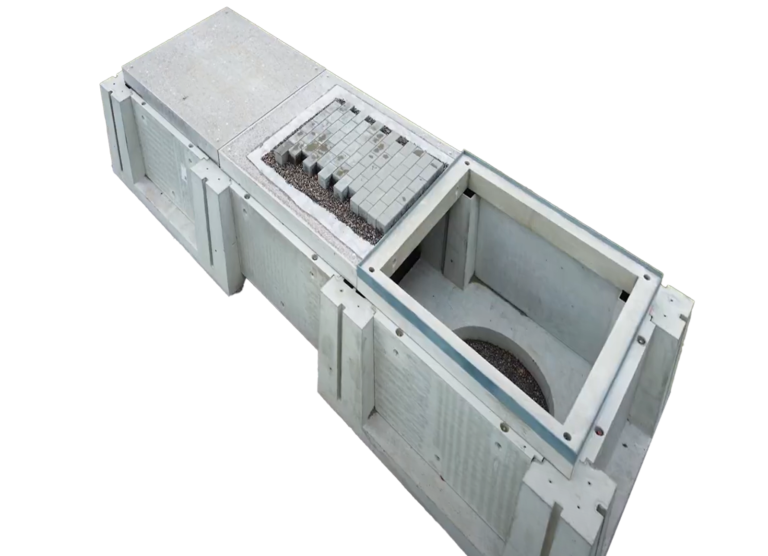
Soil cells are structures designed to allow root growth under paving. The soil cell transports traffic loads beyond the rooting zone. The soil in the open construction of the system is thus completely protected from any compaction caused by road construction and or traffic movements.
Soil cells provides the most ideal conditions for the tree roots and soil biology. It is a system that uses soil volumes to support not only the growth of large urban trees in confined underground locations. It can also provide powerful on-site storm water management.
Terminology may vary from one part of the world to another. We use the European definition above.
A soil cell provides the best conditions for tree root development beneath paving. Trees and also soil biology flourish best in a lightly compacted soil with sufficient organic matter. A soil cell offers these conditions. Besides theoretical calculations, also empirical and scientific comparative research show that trees in soil cells perform best. The world's most comprehensive survey conducted by Bartlett treeresearch gives a clear picture in tree growth performance in the various solutions. But besides tree-technical advantages, the soil cell offers many civil-technical advantages in comparison to other solutions. Because of these many advantages, soil cell systems are the most effective and logical choice in highly urbanised areas.